
More than one driver can be responsible for a serious car accident, particularly when one collision leads to another. A recent crash on the US-127 bypass in Anderson County shows how complicated these cases can become.
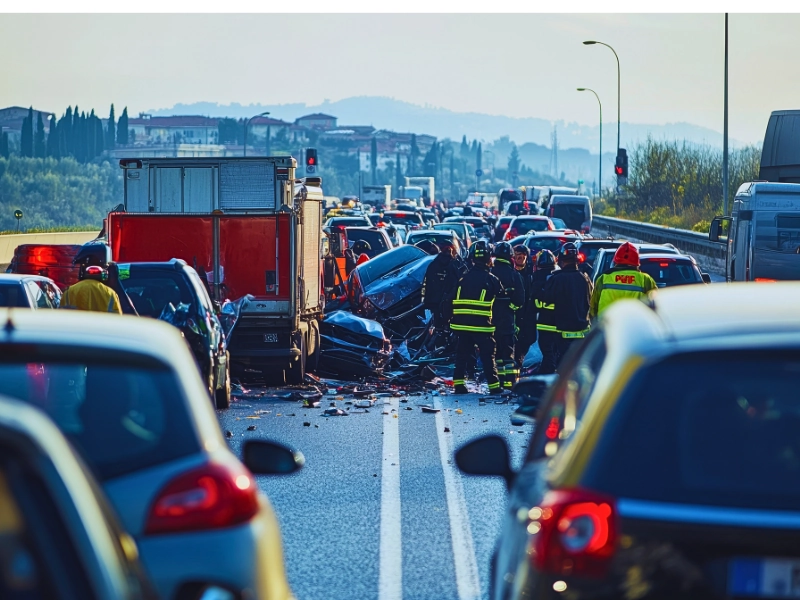
According to reports, a Toyota 4Runner was stopped in the right travel lane after an initial collision with a Chevrolet Traverse when, moments later, a tractor-trailer struck the Toyota from behind. The Toyota driver suffered serious injuries.
Cases involving multiple impacts raise important questions about what each driver did and whether those actions contributed to the injuries. If you were seriously injured in a multi-vehicle crash, our car accident lawyers can investigate the entire sequence of events and determine who may be responsible.
Call Young, Reverman & Bolotin at (513) 400-0000 for a free consultation.
Table of Contents
Key Takeaways
- A recent Anderson County crash involved an initial collision followed moments later by a tractor-trailer striking a vehicle stopped in the travel lane, illustrating how one crash can develop into a more complicated multi-vehicle accident.
- More than one driver may share legal responsibility when separate actions contribute to the same person’s injuries.
- Kentucky uses comparative fault, meaning responsibility can be divided among multiple parties based on their contribution to an accident.
- Evidence from every stage of a chain-reaction crash may matter, not just evidence concerning the final impact.
- A car accident lawyer can investigate each collision and identify the parties and insurance coverage that may be involved.
Anderson County Crash Shows How One Collision Can Lead to Another
A serious crash does not always have a single cause or a single responsible driver.
That issue is illustrated by a recent collision on the US-127 bypass south near the Bluegrass Parkway in Anderson County.
News outlets report that Kentucky State Police responded after a Toyota 4Runner was struck by a tractor-trailer. Police said the Toyota had been stopped in the right lane after an earlier collision with a Chevrolet Traverse. Then, the tractor-trailer hit the Toyota from behind.
The Anderson County Sheriff’s Office investigated the earlier collision separately, while Kentucky State Police investigated the subsequent crash involving the tractor-trailer.
That distinction matters. When one accident creates the circumstances for another, determining legal responsibility may require looking at the entire chain of events, not simply the last impact.
How Does Kentucky Comparative Fault Work in a Multi-Vehicle Accident?
Kentucky follows a pure comparative fault system. When more than one party contributes to an injury, fault can be allocated according to each party’s share of responsibility.
This is especially important in multi-vehicle accidents because liability does not necessarily have to be an all-or-nothing decision.
For example, suppose two drivers’ negligent actions contribute to a serious collision. Evidence might ultimately establish that one driver bears a greater percentage of responsibility than the other. Kentucky law allows fault to be apportioned rather than requiring all responsibility to be assigned to one person.
Comparative fault can also affect an injured person’s recovery if that person is found partially responsible. Their compensation can generally be reduced according to their percentage of fault.
This makes a thorough investigation particularly important when insurance companies disagree about how an accident happened.
Why Investigating the Entire Chain of Events Matters
In a chain-reaction crash, seconds can separate one collision from the next. Therefore, evidence from the first impact may be just as important as evidence from the final one.
The Anderson County crash is a useful example. Authorities were dealing with an initial collision involving the Toyota and Chevrolet and a later collision involving the Toyota and tractor-trailer. Understanding how those events relate to each other could require examining evidence from both crashes.
Why Identifying Every Responsible Party Can Affect Compensation
Serious injuries can lead to substantial losses. An injured person may face hospital bills, follow-up treatment, rehabilitation, lost income, reduced earning ability, pain and suffering, and long-term medical needs.
When multiple parties contributed to those injuries, identifying all responsible parties can become an important part of pursuing fair compensation.
Insurance companies may also disagree with one another. One insurer might argue that another driver’s conduct caused the injuries. Another may contend that the injured person bears some responsibility.
An attorney can investigate independently rather than relying solely on an insurance company’s version of events.
Talk to a Car Accident Lawyer After a Serious Multi-Vehicle Crash
The Anderson County collision demonstrates how quickly an initial accident can develop into a second, far more serious crash. A vehicle involved in one collision was reportedly stopped in a travel lane when it was struck by a tractor-trailer, leaving its driver seriously injured.
Authorities were still investigating, and no final conclusions about legal responsibility should be drawn from the initial news report. But crashes like this show why determining fault may require examining every event leading up to the injury.
If you or a loved one was seriously hurt in a multi-vehicle or chain-reaction accident, Young, Reverman & Bolotin can investigate the crash, deal with the insurance companies, and explain your options for pursuing compensation.
Call us today at (513) 400-0000 for a free consultation with an experienced car accident lawyer.
Frequently Asked Questions About Multi-Vehicle Car Accidents
What if the other drivers blame each other for my injuries?
Disputes between drivers and their insurance companies are common in multi-vehicle accidents. You do not necessarily have to determine on your own which driver’s version is correct. Evidence from the scene, witnesses, vehicle data, police investigations, and other sources can help establish how the crash occurred and who may be responsible.
Can I make a claim if one of the responsible drivers was uninsured?
Options may still exist. Depending on your insurance policy and the circumstances of the accident, uninsured or underinsured motorist coverage could become relevant. An attorney can review the available insurance policies and determine what coverage may apply.
What if I were a passenger in one of the vehicles?
An injured passenger may have claims involving one or more drivers depending on who contributed to the accident. Because passengers generally are not controlling either vehicle, determining which driver or drivers caused their injuries may require investigating each part of the collision.


