
Store owners are not automatically responsible whenever someone gets hurt, but they may be legally accountable when an unsafe property condition causes an injury and the evidence shows that reasonable steps could have prevented the incident. Understanding when store owners are responsible for customer injuries can help you determine whether an accident may support an Ohio premises liability claim.
If you were injured at a store and believe unsafe conditions contributed to your accident, contact Young, Reverman & Bolotin at (513) 400-0000 to discuss your circumstances with a premises liability lawyer.
Table of Contents
Key Takeaways
- Store owners generally have a duty to take reasonable measures to keep areas used by customers reasonably safe.
- Liability often depends on whether the business knew or should have known about a dangerous condition.
- Spills, damaged flooring, poorly maintained entrances, falling merchandise, and unsafe parking areas can cause customer injuries.
- A store is not automatically negligent simply because an accident occurred on its property.
- Surveillance footage, photographs, incident reports, witness statements, and maintenance records can be important evidence.
- Ohio law can reduce or prevent recovery when an injured customer shares responsibility for an accident.
- Promptly documenting the hazard can be important because dangerous conditions may be repaired or removed soon after an incident.
When Can a Store Be Liable for a Customer’s Injury?
A store owner’s responsibility generally depends on why the accident happened, not simply where it happened. A customer who enters a business to shop is ordinarily there for the store’s benefit as well as their own. That relationship can impose duties on the business regarding reasonably safe premises.
Cases involving premises liability in Ohio frequently focus on whether the business failed to use reasonable care concerning a hazardous condition.
For example, imagine that liquid spills in a grocery aisle. If an employee sees the spill but leaves it unattended for an extended period, and a customer later slips and suffers an injury, the store’s response to the known hazard may become central to a claim.
The analysis can be more difficult when nobody knows exactly how long the spill was present. Evidence about inspection practices, employee activity, surveillance recordings, and the condition of the spill itself may become important.
What Duty Do Ohio Store Owners Owe Customers?
Ohio businesses generally must exercise reasonable care toward customers who are lawfully on their property. However, the existence of an injury does not establish that the business breached its duty.
The condition of the property may also be affected by state and local safety requirements. A statutory or code issue can be relevant to an investigation, but liability still depends on the circumstances. An attorney may examine whether the store complied with relevant requirements and whether any violation is legally connected to the customer’s injury.
Does the Store Need to Have Known About the Hazard?
Knowledge is often one of the most important issues in a premises liability case. Depending on the facts, an injured customer may need evidence showing that the business created the hazard, actually knew about it, or should reasonably have discovered it.
Actual Knowledge
Actual knowledge may exist when an employee personally observes a dangerous condition, receives a customer complaint, or is informed about the problem by another worker. Internal communications, maintenance requests, incident records, or witness testimony may help establish actual notice.
Constructive Knowledge
A business cannot necessarily avoid responsibility simply by claiming that no employee reported the hazard. The question may instead become whether the dangerous condition existed long enough that reasonable care would have led to its discovery.
Suppose a leaking freezer repeatedly leaves water on a supermarket floor. Prior maintenance requests, previous cleanups, or complaints could potentially show that the condition was not an isolated surprise.
What Types of Hazards Are Stores Often Liable for?
Retail businesses can contain many hazards because merchandise, customers, employees, carts, deliveries, and equipment constantly move through the property.
Spills and Wet Floors
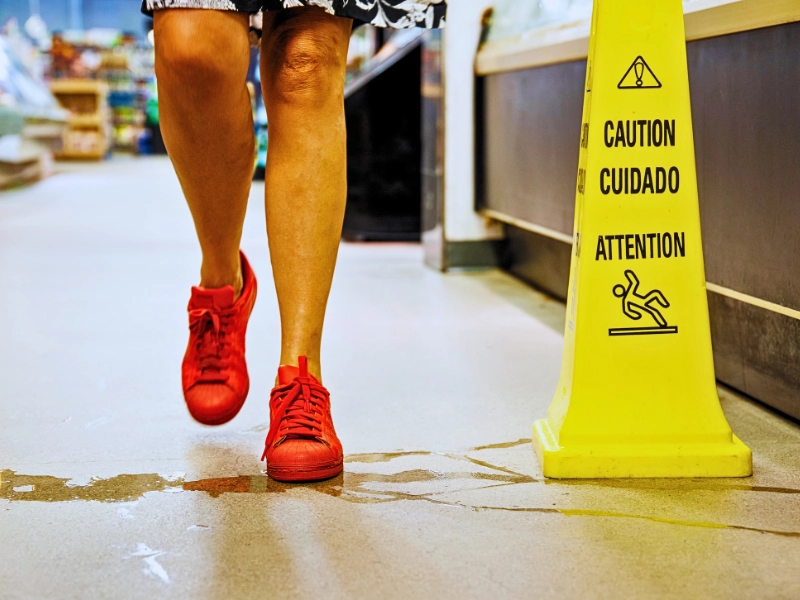
Liquid on a walking surface is one of the most familiar retail hazards. Common examples include spilled beverages, leaking refrigerators, recently mopped floors, tracked-in rain, and broken containers.
A key question is often whether employees knew about the condition or whether it existed long enough that reasonable inspections should have discovered it.
Warning cones or signs can matter, but merely placing a warning nearby does not necessarily resolve every question. The location and visibility of the warning, the nature of the hazard, and whether the store could reasonably have corrected the condition may all be relevant.
Damaged Floors and Walkways
Loose flooring, torn carpeting, uneven surfaces, damaged mats, broken pavement, and unexpected elevation changes can cause trips and falls.
Stores should have reasonable procedures for identifying and addressing property conditions that pose foreseeable risks to customers. Inspection and repair records may help establish whether a problem was previously reported or allowed to remain.
Falling Merchandise
Retailers sometimes stack merchandise on shelves above customers’ heads. Poorly secured, overloaded, or improperly arranged products can fall and cause head, neck, shoulder, or other injuries.
A falling-merchandise claim may require investigation into how the products were stocked, whether employees followed company procedures, and whether similar problems occurred previously.
Are Store Owners Responsible for Parking Lot Injuries?
A customer’s interaction with a business often begins before reaching the front door. Parking lots, sidewalks, ramps, and entrances can create premises liability issues of their own.
Whether a property owner is liable for a parking lot injury depends on factors such as the nature of the hazard, notice, maintenance responsibilities, and how the accident occurred.
Parking-area hazards can include:
- Broken pavement or significant surface defects
- Poorly maintained walkways
- Inadequate lighting in relevant circumstances
- Damaged curbs or wheel stops
- Accumulated debris
- Unsafe traffic patterns
- Hazards near entrances and pedestrian routes
Responsibility can become complicated when the store leases its location rather than owning the property. A lease may assign certain maintenance responsibilities to a landlord, tenant, management company, or another party.
Can Stores Be Liable When Vehicles Crash Into the Building?
Some retail injury cases involve risks beyond slips and falls. Vehicles can enter storefronts, pedestrian areas, or building entrances, injuring customers and employees.
Claims involving premises liability at retail stores after a vehicle-into-building collision may require examining both the driver’s conduct and the property’s design.
For example, an investigation could consider the location of parking spaces relative to entrances, previous incidents, barriers or protective features, and whether the particular type of collision was reasonably foreseeable.
These cases can involve multiple responsible parties, making early preservation of evidence particularly important.
Is a Store Automatically Responsible for a Slip and Fall?
An injury alone does not prove negligence. A person may fall without any dangerous property condition, or a hazard may arise so shortly before an accident that employees had no reasonable opportunity to discover it.
Ohio premises liability cases can also involve the nature and visibility of the condition. A store may argue that a hazard was sufficiently apparent that a reasonable customer should have noticed and avoided it.
What If You Were Partly Responsible for the Accident?
A store may argue that your own actions contributed to your injury. For example, it could claim that you were distracted, ignored a warning, or failed to notice a visible condition.
Ohio uses a modified comparative negligence system. Your percentage of responsibility can therefore affect your ability to recover compensation and the amount you may receive. Under Ohio law, you can generally recover damages as long as your share of fault is not greater than the combined fault of the other responsible parties. However, your compensation is reduced according to your percentage of responsibility.
Shared fault can become a point of dispute in a store injury claim. An insurer might argue that a warning sign was visible, that you were looking at your phone, or that you should have recognized and avoided the hazard. Those arguments do not automatically establish your percentage of responsibility. The location of warnings, visibility of the dangerous condition, surveillance footage, witness statements, and other evidence can help determine what actually happened.
You should not assume that an allegation of shared fault ends your claim. Even when you may have contributed to an accident, Ohio law can still allow you to pursue compensation when another party bears a greater share of the responsibility.
When Should You Speak With an Attorney About a Store Injury?
Legal guidance may be useful when your injuries are significant, the business disputes how the accident happened, or there are questions about who controlled the property. An attorney can investigate whether the business had notice of the condition, seek relevant records, identify potentially responsible parties, and evaluate the losses resulting from your injury.
Knowing when store owners are responsible for customer injuries ultimately requires more than proving that an accident happened on commercial property. The central questions typically concern the dangerous condition, the business’s knowledge and response, and whether that condition caused your injuries.
If you were injured because of a dangerous condition at a store or other commercial property, contact Young, Reverman & Bolotin at (513) 400-0000 to discuss your legal options.


